
If you have a dog or cat, you probably know the frustration: you clean up an accident, the stain seems to disappear, and everything smells fine—until a humid day comes along and suddenly you can smell it again.
Or maybe the carpet looks perfectly clean but you still notice that unmistakable pet odor.
That’s because pet urine isn’t always a surface-level problem.
When urine soaks into carpet fibers, backing, padding, or upholstered furniture, some of the components can remain behind after the visible moisture has dried. Those residues can continue contributing to odor, particularly when moisture in the air causes them to become more noticeable again. Urine can also penetrate farther into porous materials than the visible spot suggests.
That’s why removing pet odor isn’t always as simple as spraying a deodorizer on the affected area.
In this guide, we’ll explain why pet odors linger, why they sometimes come back, what you can try at home, and when professional pet odor removal may be appropriate.
Why Does Pet Urine Smell So Strong?
Fresh urine and dried urine are two very different cleaning challenges.
When a pet has an accident, the liquid can quickly soak through the carpet’s surface and into the layers underneath. If it isn’t thoroughly extracted or treated, urine residue can remain in the carpet fibers and potentially reach the carpet backing and padding.
As the urine dries, water evaporates while less-volatile components remain behind. Uric acid and other urine residues can become difficult to remove with ordinary surface cleaning.
This is one reason a carpet can look clean while still smelling like urine.
The same principle applies to upholstered furniture. A pet that repeatedly lies on, sleeps on, or has an accident on a sofa can introduce odor-causing residues into the fabric and underlying cushion materials.
Why Does Pet Odor Come Back on Humid Days?
One of the most frustrating things about pet urine odor is when it seems to disappear—only to return when the weather gets humid.
There’s a reason homeowners often notice this.
Some urine residues left behind after drying are capable of interacting with moisture in the surrounding environment. Increased humidity can make previously dried urine odors more noticeable again.
So when someone says:
“I swear I cleaned this spot, but I can smell it again when it rains.”
They’re not necessarily imagining it.
Humidity can make lingering odor compounds more noticeable, especially when urine has penetrated beyond the carpet surface.
This is also why simply covering the smell with a fragrance may only provide temporary relief. The underlying residue hasn’t necessarily been removed.
Why Regular Carpet Cleaning May Not Solve a Pet Odor Problem
Professional carpet cleaning and pet odor treatment are related, but they’re not necessarily the same thing.
Routine carpet cleaning is designed to remove everyday soil, spots, oils, and other contaminants from carpet. Pet urine can require a more targeted approach depending on how much urine is present, how long it has been there, and how deeply it has penetrated.
For example, imagine a dog has repeatedly used the same corner of a room.
You might see a relatively small discolored area on the carpet, but the urine may have traveled farther than the visible stain. If it has reached the carpet backing or padding, cleaning only the carpet fibers may not address everything contributing to the odor.
That’s why persistent pet odor sometimes requires more than a standard cleaning pass. If you’ve already cleaned your carpet but it still smells like dog, here’s why your carpet may still smell after cleaning and what could be causing the odor.
Pet Urine Can Be Deeper Than the Visible Spot
One of the biggest challenges with pet accidents is that the visible area doesn’t always tell the whole story.
Liquid spreads as it penetrates absorbent materials. Depending on the carpet construction, amount of urine, and how long it remained wet, an accident can travel beyond the area you can see.
This is particularly important with repeated accidents.
A homeowner might think they’re treating one small spot when the affected area underneath is actually larger.
Professional pet odor treatment starts with determining where the problem areas are and how extensive they appear to be.
How UV Light Can Help Locate Hidden Pet Spots
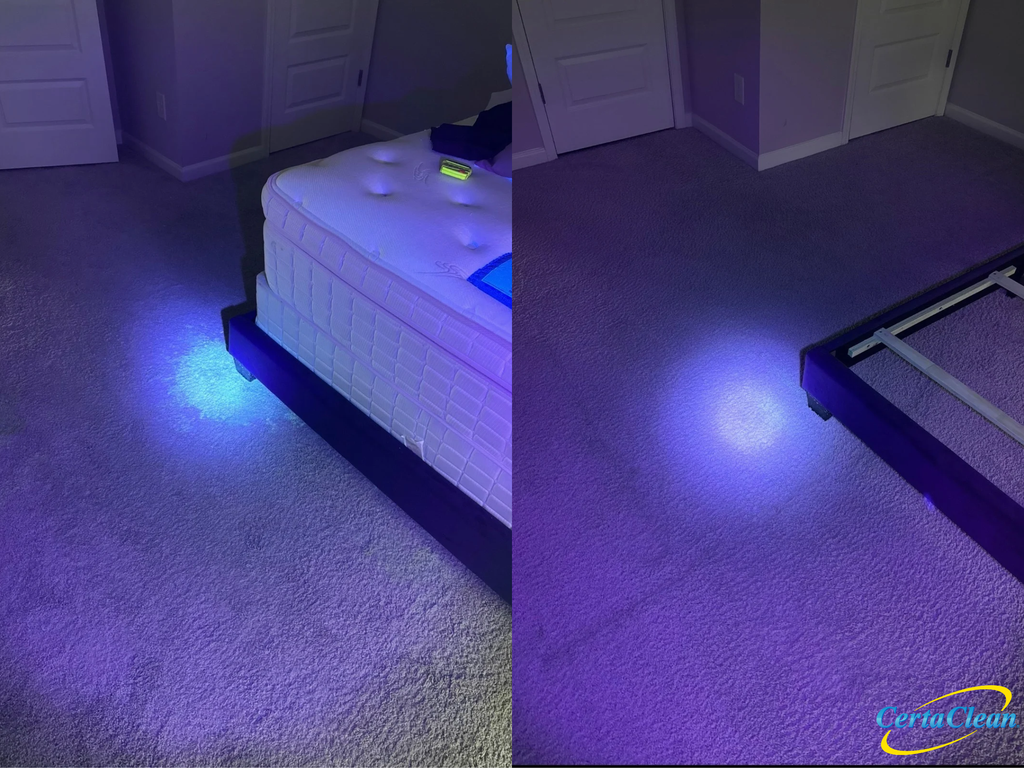
One tool that can be helpful during a pet odor inspection is a UV light.
Certain urine residues can fluoresce under ultraviolet light, making some older or otherwise difficult-to-see spots easier to locate.
UV inspection isn’t a magic detector, and not everything that fluoresces is necessarily pet urine. That’s why it should be used as one part of an overall inspection rather than treated as definitive proof on its own.
At CertaClean, UV light inspection can help us identify areas that may warrant closer attention when we’re dealing with suspected pet odor.
This is especially useful when:
- The odor is present but you can’t find the source
- A previous accident isn’t visibly stained anymore
- There have been repeated accidents in the same room
- You’re moving into a home with a history of pets
- You can smell urine but aren’t sure which areas are affected
How Professional Pet Odor Removal Works
There’s no single treatment that is appropriate for every pet odor problem.
The right approach depends on the material, severity of the contamination, location of the odor, and how deeply the urine has penetrated.
At CertaClean, our process can include several steps.
1. Inspect the affected areas
We start by looking at the carpet or upholstery and assessing the condition of the material.
For suspected urine contamination, UV light may also be used to help identify areas that aren’t obvious during a normal visual inspection.
2. Determine the extent of the problem
We consider factors such as:
- How old the accident is
- Whether accidents have occurred repeatedly
- The size of the affected area
- Whether odor is coming from carpet or upholstery
- Whether urine may have reached underlying materials
- The type and condition of the material being treated
This matters because treating a fresh, isolated accident is very different from addressing years of repeated pet accidents.
3. Apply targeted treatment
Pet odor treatment is designed to address the residues contributing to the odor rather than simply covering them with fragrance.
CertaClean uses targeted cleaning solutions formulated specifically for the treatment we’re performing. In appropriate situations, these treatments are used to help break down and remove urine-related residues.
Yes, we formulate our own solutions for our cleaning processes.
4. Extract and remove contaminants
After appropriate treatment and agitation, professional extraction equipment can be used to remove loosened soil, cleaning solution, and contaminants from the material.
For carpet, this may involve our truck-mounted hot water extraction system.
5. Evaluate the results
Severe or long-standing pet contamination can be more complicated than a single accident.
In some situations, urine may have penetrated into carpet padding or other underlying materials. Cleaning the carpet itself may reduce the odor substantially, but it cannot guarantee complete removal when contamination has reached materials that cannot be adequately cleaned from above.
That’s an important distinction—and one we believe homeowners should understand before paying for a treatment.
What About Pet Odor in Sofas and Upholstered Furniture?
Pet odor isn’t limited to carpet.
Sofas, couches, sectionals, chairs, and other upholstered furniture can also absorb pet odors over time.
Pets spend a lot of time on furniture, and their fur, oils, saliva, dirt, and occasional accidents can all contribute to buildup.
For a piece of furniture with a pet odor problem, the cleaning process has to take the upholstery fabric and construction into consideration.
Different fabrics can react differently to moisture and cleaning solutions, so upholstery shouldn’t simply be treated like carpet.
Professional Upholstery & Sofa Cleaning
Can professional sofa cleaning remove pet odors?
It can help substantially when the odor is primarily coming from contaminants that can be reached and removed through appropriate upholstery cleaning.
However, results depend on the severity and location of the contamination.
For example, if a pet repeatedly urinates on a sofa cushion and the urine penetrates deeply into the cushion’s interior, cleaning the surface fabric alone may not address everything.
That’s why inspection and realistic expectations are important.
What Can You Do at Home After a Pet Accident?
If you catch an accident right away, acting quickly is helpful.
The first priority is to absorb as much of the liquid as possible.
Blot rather than scrub
Use clean, absorbent paper towels and press firmly to absorb the urine.
Avoid aggressive scrubbing, which can spread the liquid through the fibers.
Blanket the spot with salt
Apply a heavy coating of salt, blanketing the top of the urine spot. Apply more clean paper towels on top of the spot and salt, and step firmly on top of the paper towel to help absorb as much of the liquid as possible. Let this sit for 15 minutes.
Vacuum the salt
Using a vacuum, suck up the salt that you used to soak up the liquid.
Mist with hydrogen peroxide
Anything that remains, mist some hydrogen peroxide (from the drug store) on top of the spot and leave it.
Why DIY Pet Odor Removal Sometimes Doesn’t Work
Pet odor can be difficult to treat because the source isn’t always limited to the surface of the carpet or upholstery. When urine has penetrated into the carpet fibers, backing, padding, or cushion materials, treating only the visible area may not address everything contributing to the odor.
This is why CertaClean generally does not recommend trying to treat persistent pet odors with store-bought odor removers or deodorizers. Applying additional products can leave behind residues or make it more difficult to determine exactly what is contributing to the odor.
For a minor, fresh accident, prompt cleanup may be all that’s needed. But when an odor persists, keeps returning, covers a larger area, or you’re not sure where the source is, it’s usually better to have the affected area properly inspected before applying additional products.
When Should You Consider Professional Pet Odor Removal?
Professional pet odor treatment may be worth considering when:
- The urine smell keeps coming back
- The odor becomes stronger on humid days
- You can’t find the source of the smell
- There have been repeated accidents in the same area
- Your home has a noticeable pet odor even after regular cleaning
- You’re dealing with urine stains throughout multiple rooms
- A previous DIY treatment didn’t solve the problem
- You’re preparing a home for sale
- You’ve moved into a home where previous pets may have left behind odors
- Your sofa, couch, sectional, or other upholstered furniture has persistent pet odor
A professional can evaluate the material and determine whether targeted treatment is appropriate.
Can Every Pet Odor Be Completely Removed?
This is one of the most important questions to ask—and the honest answer is no.
The potential for odor removal depends on several factors.
A recent accident on the surface of a synthetic carpet is a very different situation from years of repeated urine contamination that has saturated the carpet and padding.
If urine has penetrated deeply into materials that cannot be adequately accessed or cleaned, complete odor removal may not be possible through surface cleaning alone.
That’s why a reputable cleaning company should evaluate the situation rather than promise that every odor can be completely eliminated.
At CertaClean, we would rather explain what we’re seeing and what we realistically expect from the treatment than promise a result before we know what we’re dealing with.
Pet Odor Removal in Athens, Watkinsville & Northeast Georgia
CertaClean provides professional pet stain and odor treatment for homeowners throughout Athens and surrounding Northeast Georgia communities.
We serve homeowners in areas including Athens, Watkinsville, Oconee County, Statham, Winder, Hoschton, Braselton, Gainesville, Greensboro, Jefferson, Bogart, and nearby communities.
If you’re dealing with a lingering dog urine smell, cat urine odor, or another persistent pet odor in your carpet or upholstery, we can evaluate the affected material and determine what type of treatment may be appropriate.
Ready to Book? Book Online Here!
Final Thoughts: Pet Odor Usually Requires Treating the Source
When pet odor keeps coming back, adding another deodorizing spray may not be the answer.
The bigger question is: where is the odor coming from, and what material has absorbed it?
Pet urine can penetrate carpet fibers, backing, padding, and upholstery, leaving behind residues that are difficult to address with ordinary surface cleaning. Humidity can make lingering odors especially noticeable.
For minor, fresh accidents, prompt cleanup at home may be enough. For persistent or recurring odors, a professional inspection can help determine whether the problem is something that can reasonably be treated through cleaning.
At CertaClean, our goal isn’t simply to make a room smell better for a few hours. We want to identify the source of the odor, determine what the material can reasonably be treated for, and use an appropriate cleaning and odor-treatment process.
If you’re dealing with a pet odor that just won’t go away, reach out to CertaClean and let us take a look.
Frequently Asked Questions About Pet Odor Removal
How do you get pet urine smell out of carpet?
Fresh accidents should be blotted promptly to remove as much liquid as possible. For persistent odors, professional pet odor removal may be appropriate, particularly when urine has penetrated into carpet fibers, backing, or padding.
Why does my carpet smell like urine when it’s humid?
Humidity can make lingering urine odors more noticeable. Dried urine can leave residues behind in carpet and other porous materials, and increased moisture in the environment can contribute to the reactivation or release of odor compounds.
Can regular carpet cleaning remove pet urine odor?
Regular professional carpet cleaning can remove a significant amount of soil and contaminants, but persistent pet urine odor may require a more targeted treatment. The appropriate approach depends on how severe the contamination is and how deeply the urine has penetrated.
Can UV light find pet urine?
UV light can help identify some urine-affected areas that aren’t obvious during a normal visual inspection. However, not everything that fluoresces under UV light is necessarily urine (could be other forms of biological spots), so it should be considered an inspection aid rather than definitive proof.
Can pet urine odor be removed from a couch or sofa?
Professional sofa and upholstery cleaning can help remove pet-related soil and odor from fabrics, but the outcome depends on where the urine has penetrated and the construction of the furniture. Deep contamination inside cushions or other materials can be more difficult to treat. However, we have successfully treated pet odors and stains several times, and we always give it our best effort.
Why does my house still smell like dog even after cleaning?
The source may be deeper than the surfaces that were cleaned. Pet odors can come from carpet, padding, rugs, upholstery, pet bedding, or other porous materials. Repeated accidents can also create multiple odor sources that aren’t immediately visible.
Is professional pet odor removal worth it?
It can be particularly useful when an odor is persistent, recurring, widespread, or difficult to locate. A professional inspection can help determine whether the affected material can be effectively treated and what type of cleaning is appropriate.
Will professional carpet cleaning completely remove pet urine odor?
Complete removal cannot be guaranteed in every situation. Results depend on the severity, age, and extent of the contamination and whether urine has reached materials that cannot be adequately cleaned. A professional should evaluate the situation and set realistic expectations before treatment.